The piece of text below is a shortened, hashed representation of this content. It is useful to ensure the content has not been tampered with, as a single modification would result in a totally different value.
Value:
f5de895b00b0b2559e7afcd80a2b16ad7baeace155ecb051ad8c58c84a82976a
Source:
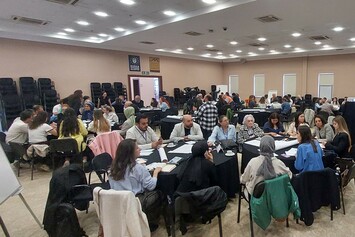
{"body":{"en":"<p>The primary objective of the KAT-MEK practice is to pioneer the redesign of public buildings through a 'Participatory Design Approach' by extending Bursa's long-standing tradition of local participation into a spatial dimension. The practice focuses on improving the Bursa City Council building in line with user needs. Spatial inefficiencies, orientation difficulties, and accessibility issues within the complex necessitated establishing a balance between preserving the historical fabric and meeting modern civil society needs.</p><p>The practice was carried out using a 'Tripartite Sector Cooperation' model, bringing together local government (Bursa Metropolitan Municipality), academia (Bursa Uludag and Bursa Technical Universities) and civil society (Bursa City Council). The methodology consists of a seven-stage framework that places the user at the centre of every stage of the design process. The process began with data obtained from a digital survey answered by the users of the building. Design decisions were then concretised through a 'Preliminary Design Workshop' attended by academics, design students, council volunteers, and representatives of municipal subsidiaries using different areas on the same site. Five different spatial alternatives produced by design teams consisting of undergraduate and postgraduate students from the Architecture and Landscape Architecture Departments of the city's two universities, were presented to the public and stakeholders for voting through a 'Design Colloquium' and exhibitions held in both physical and digital environments. A thematic analysis of the collected user feedback identified the most popular design elements. Based on this data, the design team collaborated to create the final design.</p><p>As a result, KAT-MEK has transformed public buildings from mere administrative structures into 'social dialogue laboratories' shaped by the common wisdom of the city. This pilot model, which advocates the principles of 'co-governance' and 'right to the city' against the tradition of expert-focused architecture has been documented, gaining the status of a scientific guide applicable to different public structures. It has contributed to the institutionalisation and sustainability of participatory democracy and reinforced the transparency of the process. In the future, as this methodology is implemented for different public buildings, the aim is to maximise social belonging and spatial efficiency.</p><p>More information about: <a href=\"https://www.bursakentkonseyi.org.tr/\"><u>https://www.bursakentkonseyi.org.tr/</u></a> </p><p>Video: <a href=\"https://youtu.be/WuQi_ASq1Dk\"><u>https://youtu.be/WuQi_ASq1Dk</u></a> </p>","es":"<p>El objetivo principal de la práctica KAT-MEK es impulsar el rediseño de los edificios públicos mediante un enfoque de diseño participativo, extendiendo la larga tradición de participación local de Bursa hacia la dimensión espacial. La iniciativa se centra en mejorar el edificio del Consejo de la Ciudad de Bursa de acuerdo con las necesidades de sus usuarios. Las ineficiencias espaciales, las dificultades de orientación y los problemas de accesibilidad dentro del complejo hicieron necesario encontrar un equilibrio entre la preservación del patrimonio histórico y la respuesta a las necesidades contemporáneas de la sociedad civil.</p><p>La práctica se llevó a cabo mediante un modelo de cooperación triangular, que reunió al gobierno local (Municipalidad Metropolitana de Bursa), la academia (Universidades Bursa Uludağ y Bursa Technical) y la sociedad civil (Consejo de la Ciudad de Bursa). La metodología consiste en un marco de siete etapas que sitúa al usuario en el centro de cada fase del proceso de diseño. El proceso comenzó con la recopilación de datos a través de una encuesta digital respondida por los usuarios del edificio. Posteriormente, las decisiones de diseño se concretaron mediante un taller de prediseño en el que participaron académicos, estudiantes de diseño, voluntarios del consejo y representantes de empresas municipales que utilizan distintos espacios del mismo recinto. Cinco alternativas espaciales diferentes, producidas por equipos de diseño formados por estudiantes de grado y posgrado de los departamentos de Arquitectura y Arquitectura del Paisaje de las dos universidades de la ciudad, fueron presentadas al público y a los actores implicados para su votación a través de un coloquio de diseño y exposiciones realizadas tanto en entornos físicos como digitales. Un análisis temático de los comentarios de los usuarios permitió identificar los elementos de diseño más valorados. Con base en estos datos, el equipo de diseño colaboró en la creación del diseño final.</p><p>Como resultado, KAT-MEK ha transformado los edificios públicos de simples estructuras administrativas en verdaderos “laboratorios de diálogo social” configurados por la inteligencia colectiva de la ciudad. Este modelo piloto, que defiende los principios de cogobernanza y derecho a la ciudad frente a la tradición de una arquitectura centrada en expertos, ha sido documentado y ha adquirido el estatus de guía científica aplicable a diferentes estructuras públicas. Asimismo, ha contribuido a la institucionalización y sostenibilidad de la democracia participativa y ha reforzado la transparencia del proceso. En el futuro, al aplicar esta metodología a otros edificios públicos, se pretende maximizar el sentido de pertenencia social y la eficiencia espacial.</p><p>Más información:<br><a href=\"https://www.bursakentkonseyi.org.tr/\"> <u>https://www.bursakentkonseyi.org.tr/</u></a></p><p>Video: <a href=\"https://youtu.be/WuQi_ASq1Dk\"><u>https://youtu.be/WuQi_ASq1Dk</u></a> </p>","fr":"<p>L’objectif principal de la pratique KAT-MEK est de promouvoir la reconception des bâtiments publics à travers une approche de conception participative, en étendant la longue tradition de participation locale de Bursa à la dimension spatiale. L’initiative se concentre sur l’amélioration du bâtiment du Conseil municipal de Bursa en fonction des besoins de ses utilisateurs. Les inefficacités spatiales, les difficultés d’orientation et les problèmes d’accessibilité au sein du complexe ont rendu nécessaire l’établissement d’un équilibre entre la préservation du patrimoine historique et la réponse aux besoins contemporains de la société civile.</p><p>La pratique a été mise en œuvre selon un modèle de coopération tripartite, réunissant le gouvernement local (Municipalité métropolitaine de Bursa), le monde académique (universités Bursa Uludağ et Bursa Technical) et la société civile (Conseil municipal de Bursa). La méthodologie repose sur un cadre en sept étapes qui place l’utilisateur au centre de chaque phase du processus de conception. Le processus a commencé par la collecte de données à partir d’une enquête numérique remplie par les utilisateurs du bâtiment. Les décisions de conception ont ensuite été concrétisées lors d’un atelier de préconception réunissant universitaires, étudiants en design, volontaires du conseil et représentants des filiales municipales utilisant différents espaces du site. Cinq propositions spatiales différentes, élaborées par des équipes de conception composées d’étudiants de premier et de deuxième cycle des départements d’architecture et d’architecture paysagère des deux universités de la ville, ont été présentées au public et aux parties prenantes pour vote lors d’un colloque de conception et d’expositions organisées à la fois dans des environnements physiques et numériques. Une analyse thématique des retours des utilisateurs a permis d’identifier les éléments de conception les plus appréciés. Sur la base de ces données, l’équipe de conception a collaboré pour élaborer le projet final.</p><p>Ainsi, KAT-MEK a transformé les bâtiments publics, passant de simples structures administratives à de véritables « laboratoires de dialogue social » façonnés par l’intelligence collective de la ville. Ce modèle pilote, qui défend les principes de cogouvernance et de droit à la ville face à la tradition d’une architecture centrée sur l’expertise, a été documenté et a acquis le statut de guide scientifique applicable à différentes structures publiques. Il a contribué à l’institutionnalisation et à la durabilité de la démocratie participative tout en renforçant la transparence du processus. À l’avenir, l’application de cette méthodologie à d’autres bâtiments publics vise à maximiser le sentiment d’appartenance sociale et l’efficacité spatiale.</p><p>Plus d’informations :<br><a href=\"https://www.bursakentkonseyi.org.tr/\"> <u>https://www.bursakentkonseyi.org.tr/</u></a></p><p>Video: <a href=\"https://youtu.be/WuQi_ASq1Dk\"><u>https://youtu.be/WuQi_ASq1Dk</u></a> </p>"},"title":{"en":"Bursa: KAT-MEK Spatial Improvement of Public Buildings through Participatory Design: The Case of Bursa City Council Campus","es":"Bursa: KAT-MEK – Mejora espacial de edificios públicos mediante diseño participativo: el caso del campus del Consejo de la Ciudad de Bursa","fr":"Bursa : KAT-MEK – Amélioration spatiale des bâtiments publics par la conception participative : le cas du campus du Conseil municipal de Bursa"}}
This fingerprint is calculated using a SHA256 hashing algorithm. In order to replicate it yourself, you can use an MD5 calculator online and copy-paste the source data.






Share
Or copy link